



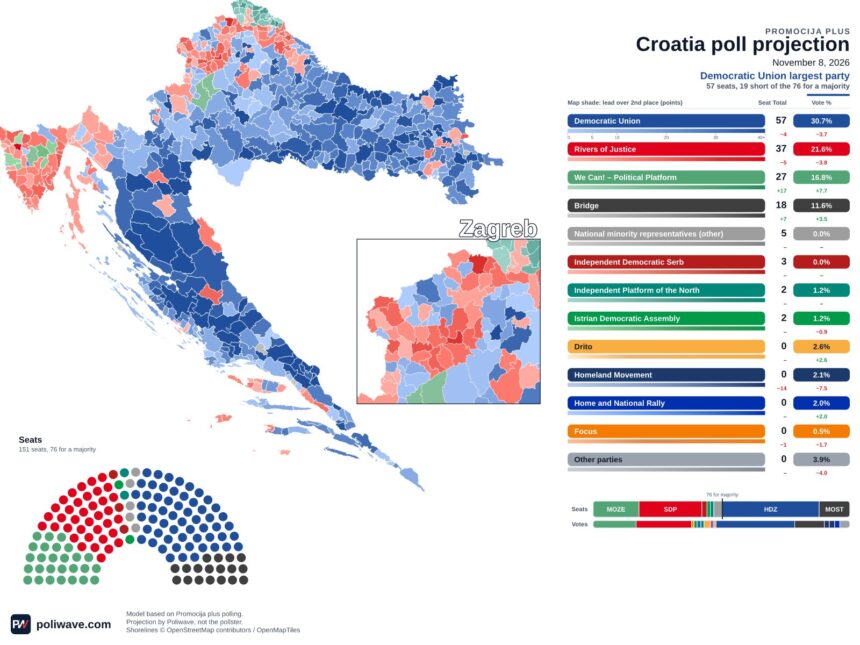
How would Croatia’s 151-member parliament look if the latest national polling figures were translated into constituency-level seats? Electoral projection platform Poli Wave has applied its election model to the Promocija plus poll dated 8 November 2026. Its current seat projection puts HDZ on 57 mandates, SDP on 37, Možemo! on 27 and Most on 18. The model also assigns two seats each to IDS and NPS, alongside Croatia’s eight national-minority seats.
- What the 8 November opinion poll reported
- Poli Wave’s projected distribution of 151 Sabor seats
- Full seat projection for all 12 constituencies
- Estimated party support by constituency
- How Poli Wave calculates its constituency projections
- How projected vote shares become seats
- What the projection does not tell us
Attribution matters: This is Poli Wave’s projection, based on a national opinion poll conducted by Promocija plus. Promocija plus supplied the poll figures, not the parliamentary seat forecast. The results reproduced below are Poli Wave’s own constituency estimates, not calculations or an electoral forecast produced by Votendi. All figures refer to the Poli Wave model snapshot checked on 11 November 2026.
What the 8 November opinion poll reported
The Promocija plus CRO Demoskop poll lists HDZ at 24.9%, SDP at 17.5%, Možemo! at 13.6% and Most at 9.4%. The poll page also lists a broad 21.1% N/A category. These are national polling figures, not regional vote shares and not parliamentary seat percentages.
The poll’s national figures form the starting point for the separate Poli Wave model. Its modeled party-vote estimates are adjusted for regional distribution and its election-calculation inputs, so they should not be read as identical to the original poll percentages. In particular, a small party with geographically concentrated support can receive seats in a particular district even when it polls at a much lower percentage nationwide.
Poli Wave’s projected distribution of 151 Sabor seats
| Party / parliamentary group | Seats shown by Poli Wave |
|---|---|
| HDZ | 57 |
| SDP | 37 |
| Možemo! | 27 |
| Most | 18 |
| IDS | 2 |
| NPS | 2 |
| SDSS (minority seats) | 3 |
| Other minority representatives | 5 |
| Total | 151 |
The parliamentary majority threshold is 76 seats. These numbers describe Poli Wave’s modeled seat allocation rather than an election result or a statement about which parties would form a coalition. Of the total, 143 seats are distributed across Croatia’s ten regular electoral constituencies and the three-seat diaspora constituency; the remaining eight are the separate national-minority seats.
Full seat projection for all 12 constituencies
Each of constituencies I–X returns 14 members. Constituency XI elects three representatives of citizens abroad, while constituency XII elects eight representatives of national minorities under separate electoral rules. The table reproduces Poli Wave’s own district-by-district seat figures and shows every allocated parliamentary seat.
| Constituency | HDZ | SDP | Možemo! | Most | IDS | NPS | SDSS | Other minority seats | Seats |
|---|---|---|---|---|---|---|---|---|---|
| I | 4 | 3 | 5 | 2 | – | – | – | – | 14 |
| II | 6 | 3 | 3 | 2 | – | – | – | – | 14 |
| III | 4 | 5 | 2 | 1 | – | 2 | – | – | 14 |
| IV | 7 | 4 | 2 | 1 | – | – | – | – | 14 |
| V | 8 | 3 | 1 | 2 | – | – | – | – | 14 |
| VI | 4 | 3 | 5 | 2 | – | – | – | – | 14 |
| VII | 6 | 4 | 2 | 2 | – | – | – | – | 14 |
| VIII | 3 | 5 | 3 | 1 | 2 | – | – | – | 14 |
| IX | 6 | 3 | 2 | 3 | – | – | – | – | 14 |
| X | 6 | 4 | 2 | 2 | – | – | – | – | 14 |
| XI (diaspora) | 3 | – | – | – | – | – | – | – | 3 |
| XII (national minorities) | – | – | – | – | – | – | 3 | 5 | 8 |
| Total | 57 | 37 | 27 | 18 | 2 | 2 | 3 | 5 | 151 |
According to Poli Wave, HDZ receives 54 seats in the ten territorial constituencies and three more in the diaspora constituency. SDP’s 37, Možemo!’s 27, Most’s 18, IDS’s two and NPS’s two all come from constituencies I–X. The model carries three SDSS minority seats and five other minority representatives in constituency XII; those eight are not determined by a standard national party-vote poll.
Estimated party support by constituency
These percentages are Poli Wave’s modeled regional estimates derived from national poll inputs and historical voting patterns. They are not independent polls of voters in each district. The table includes the four largest national parties, plus IDS and NPS, which are relevant in specific regions. Values are shown as reported by the model to two decimal places.
| Constituency | HDZ | SDP | Možemo! | Most | IDS | NPS | Highest modeled share |
|---|---|---|---|---|---|---|---|
| I | 23.32% | 19.85% | 30.00% | 10.46% | 0.40% | — | Možemo! |
| II | 31.55% | 21.02% | 16.53% | 12.84% | 0.53% | — | HDZ |
| III | 24.01% | 32.09% | 13.14% | 6.42% | — | 12.00% | SDP |
| IV | 38.49% | 21.74% | 12.30% | 9.35% | 0.47% | — | HDZ |
| V | 40.34% | 16.85% | 9.52% | 12.61% | 0.20% | — | HDZ |
| VI | 21.40% | 19.86% | 28.69% | 13.19% | 0.27% | — | Možemo! |
| VII | 36.51% | 21.04% | 13.87% | 10.67% | — | — | HDZ |
| VIII | 18.59% | 29.27% | 18.98% | 8.86% | 9.78% | — | SDP |
| IX | 35.80% | 16.02% | 10.47% | 16.34% | 0.41% | — | HDZ |
| X | 32.92% | 21.45% | 11.66% | 15.51% | 0.25% | — | HDZ |
| XI (diaspora) | 69.34% | — | 7.54% | 9.04% | — | — | HDZ |
Poli Wave assigns the highest modeled vote share to Možemo! in constituency I (30.00%) and constituency VI (28.69%). SDP has the highest modeled share in constituency III (32.09%) and constituency VIII (29.27%). HDZ has the highest modeled share in II, IV, V, VII, IX and X. These are modeled first-place vote shares, not guaranteed election wins.
How Poli Wave calculates its constituency projections
Poli Wave publishes a detailed description of its methodology, updated in September 2026. For this Croatia projection, the national Promocija plus figures supply the poll input, while the regional distribution is inferred where the survey does not provide a compatible regional breakdown. This regional inference is explicitly disclosed on the projection page.
The model starts with the previous election results mapped to the current electoral boundaries. It then estimates how changes in each party’s national standing might be distributed among districts. Its core formula combines two approaches: proportional swing, which responds to relative shifts in party support, and uniform swing, which responds to changes measured in percentage points. Poli Wave combines the two estimates using a geometric mean. The proportional component is calculated in log-odds space to avoid implausible outcomes near 0% or 100%.
According to Poli Wave’s documentation, the broader pipeline also has ways to reconstruct missing historical baselines, account for changes in party support and apply geographic or demographic adjustments where relevant. Finally, it reconciles its local estimates with the higher-level polling inputs. These are the platform’s published modeling capabilities; the precise contribution of every optional adjustment to this particular Croatia run is not separately documented.
How projected vote shares become seats
Croatia’s regular constituencies use proportional representation with a 5% electoral threshold in each constituency. Eligible lists then receive the 14 seats in that constituency under the D’Hondt method: vote totals are divided by 1, 2, 3 and so on, and seats go to the lists with the highest quotients. The threshold is local, which means a party can be represented in one district but absent from the seat allocation in another. The diaspora and national-minority constituencies follow their separate rules, as described in Poli Wave’s explanation of the Croatian electoral system.
This is why the model’s national seat projection differs from the poll’s national percentage ranking. In its current calculation, the ten ordinary districts account for 140 seats, the diaspora for three, and the minority constituency for eight, making the full 151.
What the projection does not tell us
Poli Wave’s figures are a conditional model estimate based on a single national survey. The pollster has not separately surveyed all constituencies to produce these numbers, and the estimated regional figures depend on assumptions about how support shifts geographically. Party alliances, the lists eventually registered, turnout, and further movement in voter preferences could all change an eventual seat distribution.
The site also describes probability simulations for some forecasts, but the figures presented here are a point estimate, not a probability distribution or a forecast of the next government’s composition. The model’s historical calibration information is largely based on Canadian elections and is not, by itself, evidence of a validated accuracy rate for Croatia.
Source and credit: Projection and all district seat/vote-share estimates: Poli Wave — Promocija plus seat projection, 8 November 2026; numerical data: Poli Wave calculation JSON; original national survey: Promocija plus poll page; Poli Wave model methodology. Reproduced by Votendi with Poli Wave’s permission and full attribution. Model snapshot checked 11 November 2026. All seat projections and district estimates are those of Poli Wave, not of Votendi or Promocija plus.
Latest Croatia Promocija plus Poll modelled out
🔵Government: 57 seats
Majority: 76
🔵HDZ: 57 seats
🔴SDP: 37 seats
🟢MOZE: 27 seats
⚫MOST: 18 seats
💙DP: 0 seats
💚IDS: 2 seats
🟩NPS: 2 seats
🧡FOKUS: 0 seats
⚪OTH: 8 seats
🔵HDZ largest party, 19 short of a majority https://t.co/jb5H5xLgqD
— Poliwave Europe (@PoliwaveEU) November 8, 2026