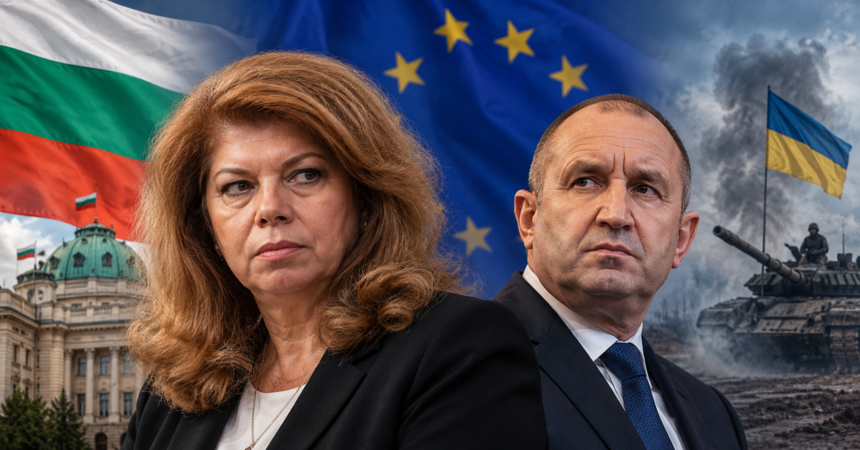
A dispute between European political families has entered Bulgaria’s presidential election campaign just two days before the November 1 runoff. The centrist European Democratic Party (EDP), associated with the Renew Europe political family, has criticised the Party of European Socialists (PES) for endorsing incumbent President Iliana Iotova, questioning whether her comments on Russia’s war in Ukraine are consistent with the European centre-left’s stated principles.
In a statement on X on October 30, the European Democrats pointed to earlier remarks in which Iotova questioned military assistance to Ukraine and called for negotiations. The party argued that the PES should explain the contrast between its support for Ukraine and its endorsement of the Bulgarian incumbent. That is an accusation made by a political rival, rather than an established finding about Iotova’s overall record.
Why the PES endorsement prompted criticism
On October 29, the Party of European Socialists declared its support for Iotova ahead of Sunday’s runoff, describing her as a social democrat committed to solidarity and European values. Iotova, a former Socialist member of the European Parliament, is supported at home by the Bulgarian Socialist Party as well as allies of former president Rumen Radev.
The European Democrats responded by highlighting Iotova’s July comments on the so-called Coalition of the Willing. As Bulgarian News Agency BTA reported at the time, she argued that the initiative had moved away from preparations for a peace settlement towards discussion of weapons and military support. She suggested that additional supplies could prolong the conflict.
The party also referred to a September interview in which Iotova was asked who the aggressor was. BTA’s media review recorded her reluctance to use that label in the interview, while also reporting that she acknowledged Russia had launched an invasion and said the war must be stopped through negotiations. Her response was criticised by Bulgarian opponents at the time.
What Iotova has said — and the wider context
Iotova has consistently urged a larger European role in negotiations and argued that lasting peace requires engaging Russia. In the October 29 televised presidential debate, she maintained that providing increasingly sophisticated weapons was not producing a settlement and called for a comprehensive agreement. Challenger Andrey Gyurov, by contrast, stressed the defence of internationally recognised borders and close cooperation with Bulgaria’s allies.
But Iotova’s record is not confined to the remarks selected for criticism. In February remarks carried by BTA, she explicitly said that she and former president Radev had referred to aggression and an aggressor. Her position therefore combines an acknowledgement of Russia’s aggression on some occasions with strong reservations about further military assistance and an emphasis on diplomacy.
The dispute illustrates a wider disagreement within European politics: whether strengthening Kyiv militarily is a necessary condition for a durable peace or whether Europe should place greater immediate emphasis on negotiations. The European Democrats frame their challenge as a question of consistency; Iotova presents her approach as one aimed at ending the war and protecting Bulgaria’s security interests.
Why this matters before Sunday’s vote
Iotova and Gyurov advanced from the October 25 first round after finishing close together, with Iotova on roughly 35% and Gyurov on about 32%. Turnout was approximately 22%, making mobilisation and the transfer of votes from eliminated candidates central to the November 1 contest.
Although the Bulgarian presidency does not direct day-to-day government policy, the president has an important constitutional and diplomatic role. The outcome will also indicate whether voters favour political continuity under Iotova or a more explicitly pro-Western counterweight associated with Gyurov.
The European-level dispute adds another dimension to the final campaign days, but it does not itself demonstrate how Bulgarian voters will respond. Read Votendi’s analysis of the wider Russia–Europe divide and its runoff voting and results guide.