
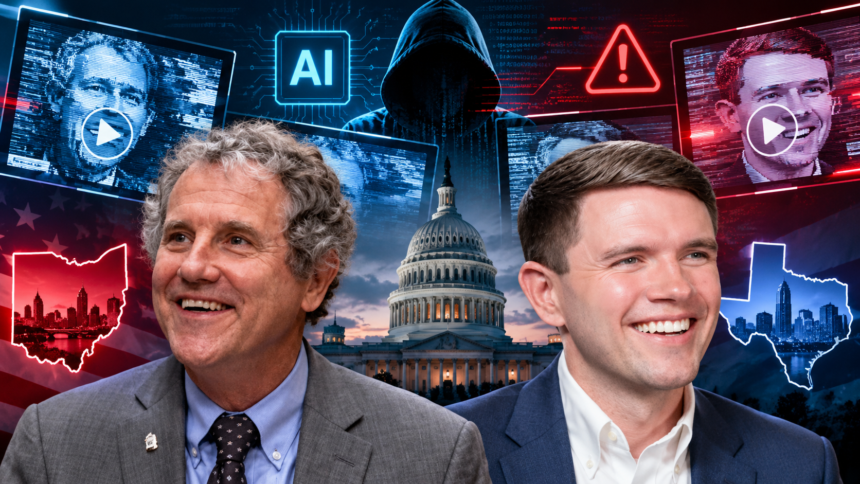
Suspected AI-generated or manipulated videos are circulating against Democratic US Senate candidates Sherrod Brown in Ohio and James Talarico in Texas, according to an Associated Press investigation published as the 2026 midterm campaign enters its final week. Specialists say the material resembles tactics used in earlier Russian influence operations, but its exact origin has not been conclusively established.
The reporting highlights a growing challenge for voters: fabricated accounts can use the names, photographs and apparent testimony of real people to make allegations look credible. The claims promoted in the videos should not be treated as established facts, and Votendi is not reproducing the clips.
What happened in Ohio and Texas?
In Ohio, where former Democratic senator Sherrod Brown is challenging Republican senator Jon Husted, one video presented itself in the style of a news broadcast. It used photographs and names associated with former Brown staff members, including Haya Akbik, a former intern.
Akbik told The Associated Press that statements attributed to her were entirely fabricated. Her response illustrates a second form of harm caused by such material: people whose identities are appropriated can become targets of accusations they never made.
In Texas, a separate video purported to show a former student speaking directly to camera about Democratic Senate candidate James Talarico, who is running against Republican Ken Paxton. Talarico’s campaign condemned the video as an AI-enabled smear. AP reported that the clip appeared to be at least partly generated or manipulated using artificial intelligence.
The specific allegations circulated in those videos have not been independently substantiated. Their apparent presentation as personal testimony or journalism does not establish authenticity.
Why are researchers examining a possible Russian connection?
Darren Linvill, a Clemson University researcher who studies influence operations, told AP that the material resembled productions associated with Storm-1516, a Russian-linked disinformation network previously connected with fabricated political videos during the 2024 US election. He also identified accounts that had circulated both the new material and older content linked to that network.
Hany Farid, a Dartmouth College specialist in digital forensics, separately assessed that both videos were probably generated or manipulated with AI. He described the Brown video as relatively unsophisticated and considered the Talarico clip more consistent with AI generation.
These are forensic assessments and indicators, not a definitive public attribution of responsibility. AP said the Russian Embassy in Washington and the US Cybersecurity and Infrastructure Security Agency had not responded to its requests for comment at the time of publication. Russia has previously denied interfering in US elections.
There is also broader context: on 21 October, Reuters reported that Democratic congressional intelligence leaders Mark Warner and Jim Himes said a classified briefing described Russian misinformation activity targeting Democrats ahead of the midterms. Those statements raise concerns about influence operations but do not independently prove who created these particular videos.
What did X remove, and why does the problem persist?
According to AP, X removed the original posts promoting the two videos and suspended the accounts responsible for sharing them, citing violations of its rules. Copies were nevertheless still available elsewhere on the platform and online, some having been shared hundreds of times.
That gap between takedown and containment matters. A misleading clip can be reposted, reframed or separated from the account that first distributed it, making its provenance harder to trace. A screenshot of a supposed broadcast or a short video of a purported witness is not itself evidence that an allegation is true.
Votendi has not independently measured the reach of the videos, identified their creators or established whether they affected voter attitudes. The available reporting supports describing this as a documented disinformation incident, not as proof of a measurable electoral effect.
Why do Ohio and Texas matter in the final week?
Both states are among the Senate contests followed by Votendi ahead of the 3 November 2026 midterm elections. Their campaigns, polling updates and contrasting messages are already subjects of intense national attention.
The disinformation story is distinct from legitimate negative advertising or disagreement over policy. Its defining concern is the use of apparently fabricated source material and misappropriated identities. Regardless of party, claims embedded in such videos need independent documentation before they can be reported as factual.
For the latest public polling and race information, see Votendi’s 2026 US midterms election hub and its Texas Senate polling analysis. Polling numbers measure reported voter preferences under a survey’s methodology; they do not establish the authenticity or impact of a circulating allegation.
What is confirmed — and what remains unknown?
Confirmed in AP’s reporting: videos targeting Brown and Talarico circulated; a former Brown intern explicitly rejected claims attributed to her; independent specialists assessed signs of manipulation; and X removed the original accounts and posts.
Not established: the identity of the person or organization that produced each clip; a definitive operational link between those specific clips and the Russian government; the total number of people exposed; and whether either video changed an election preference.
Votendi’s assessment: the relevant development is not the sensational accusations made in the clips, but the mechanism by which fabricated material may be laundered into an election debate. The responsible editorial approach is to report the documented manipulation, attribute the expert assessments precisely and avoid amplifying unverified smears.
Source: Associated Press, Ali Swenson (27–28 October 2026); Reuters (21 October 2026). This article does not reproduce or endorse the disputed claims.