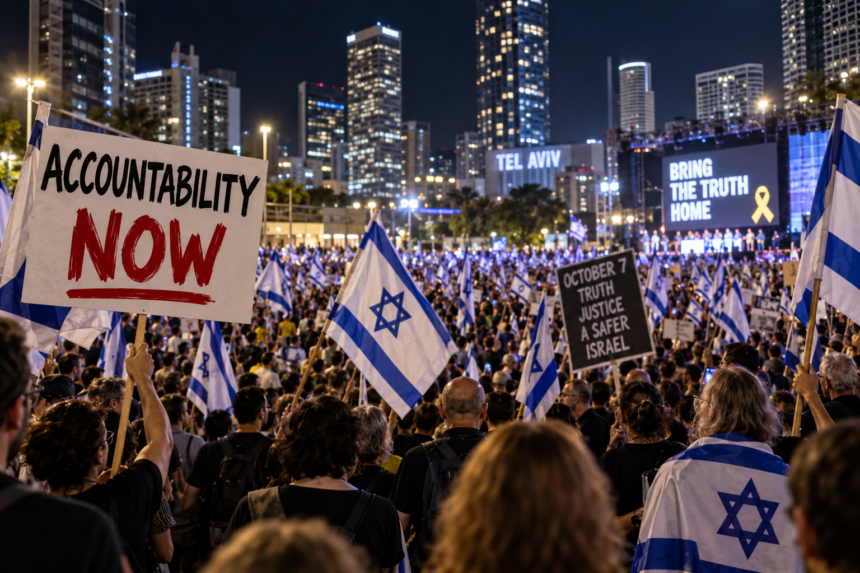
Tens of thousands of Israelis gathered in Tel Aviv on Saturday night, demanding an independent investigation into the October 7, 2023 attacks. With the parliamentary election just three days away, the demonstration brought together hostage families, survivors and leading opposition politicians in a final public confrontation over government accountability.
TEL AVIV, October 25, 2026 — A large anti-government demonstration filled Hostages Square and surrounding streets in central Tel Aviv on Saturday evening, October 24, as Israel entered the final days of its general election campaign.
Organisers claimed that more than 100,000 people attended, although no independent police estimate was available. International news agencies confirmed a substantial turnout, with demonstrators waving Israeli flags and demanding an official investigation into the security failures surrounding the Hamas-led attacks of October 7, 2023.
The rally was organised by the October Council, a movement representing survivors, former hostages and families who lost relatives during the attacks.
Its central demand was the establishment of an independent state commission of inquiry with the authority to investigate the decisions and failures of both political and security institutions.
From hostage protests to government accountability
Hostages Square became internationally recognised during the Gaza war as the focal point of demonstrations demanding the release of Israelis held captive by Hamas.
Saturday’s gathering reflected a change in emphasis.
With the hostages or their remains now returned, according to the Associated Press, families and campaigners are increasingly focused on establishing political and institutional responsibility for the events that preceded the attacks.
Speakers criticised the absence of a comprehensive independent state investigation more than three years after the attacks.
Elhanan Danino, whose son Ori was killed while held hostage in Gaza, questioned why the government had not established such an commission.
Other relatives of victims described the inquiry as necessary not only to establish responsibility for the past, but also to identify failures that could leave Israel vulnerable to future attacks.
Opposition leaders join the demonstration
The demonstration also became a significant gathering of Israel’s opposition leadership.
Gadi Eisenkot, the former military chief of staff and leader of the Yashar party, attended the protest and received an enthusiastic reception.
Other prominent opposition figures included Yair Golan, leader of the Democrats; former prime minister Naftali Bennett; Yair Lapid; and Avigdor Liberman.
Golan led supporters in a march from Rabin Square to Hostages Square and pledged to pursue an independent investigation if a new government takes office.
Their participation reinforced the connection between the protest movement’s demand for accountability and the broader electoral contest over Netanyahu’s leadership.
However, the parties represented at the demonstration retain different political programmes, and their common opposition to Netanyahu does not automatically resolve the challenge of forming a governing coalition.
Why Netanyahu opposes the proposed inquiry
Prime Minister Benjamin Netanyahu has resisted calls for a state commission of inquiry in the form demanded by the families.
His stated objection concerns the independence and impartiality of a commission whose members would be selected by the judiciary. Netanyahu argues that such a process could be biased against his government.
The protesters reject that position, insisting that an independent investigation is necessary to establish credibility and avoid political interference.
The disagreement extends beyond the question of investigating individual decisions.
A state commission of inquiry in Israel possesses significant investigative powers, including the ability to summon witnesses and examine government conduct.
Its conclusions could have lasting implications for senior political, military and intelligence officials.
The dispute also reached Israel’s Central Elections Committee before Saturday’s gathering. Netanyahu’s Likud party sought to prevent television coverage of the rally, arguing that it constituted election propaganda. The committee’s chairman rejected the request on the grounds that it lacked a sufficient factual basis.
A fragmented election makes coalition arithmetic decisive
Israel’s parliamentary election is scheduled for Tuesday, October 27.
The final opinion polls published before the election polling blackout indicated that neither of the two principal political blocs was positioned to secure an outright parliamentary majority on its own.
One survey published by public broadcaster KAN allocated 52 seats to the bloc associated with Eisenkot and 50 to Netanyahu’s bloc, leaving the remaining seats to parties outside those alignments, including Arab parties.
The Knesset has 120 seats, meaning that a governing majority requires at least 61.
These figures illustrate the fragmented political landscape, but they are estimates from a pre-election survey rather than election results.
Coalition negotiations, relations between opposition parties and the role of parties outside the main blocs will all matter after votes are counted.
Analysis: Can street protests translate into electoral change?
Saturday’s demonstration illustrates how public demands for accountability have become intertwined with Israel’s parliamentary election.
For families of victims, the immediate objective remains an independent examination of the October 7 security failures.
For opposition politicians, the issue is also part of a wider debate about Netanyahu’s leadership, public trust and the direction of the Israeli state.
The participation of prominent party leaders gave the demonstration clear electoral significance, but the size of a protest cannot establish how the wider electorate will vote.
Large demonstrations primarily measure the mobilisation of those willing and able to attend. They are not representative surveys of national voting intentions.
That distinction is particularly important in Israel’s proportional electoral system, where parliamentary seats and subsequent coalition negotiations determine who governs.
What happens next?
Israelis will elect the 120 members of the next Knesset on October 27.
The election will determine the balance of parliamentary representation, but the composition of the next government may depend on coalition negotiations following the vote.
The issue raised by Saturday’s protesters will remain relevant regardless of which parties secure the most seats: whether Israel establishes an independent state commission to examine the October 7 attacks, and under what mandate.
For Votendi’s election coverage, the next developments to monitor are voter turnout, the distribution of parliamentary seats, coalition negotiations and the next government’s approach to the proposed inquiry.
The Tel Aviv demonstration has placed accountability prominently in the closing days of the campaign. Whether it changes parliamentary representation remains a question for voters and the election results.