
Gadi Eisenkot’s Yashar party has extended its numerical lead over Prime Minister Benjamin Netanyahu’s Likud in a new Israeli election poll, but a second set of figures suggests that the parties’ supporters differ markedly in how firmly they have settled on their choices. With the Knesset election scheduled for October 27, the distinction is important — although it does not establish that those expressing less certainty will switch parties.
The Walla/Lazar Research poll published on October 20 projects 23 of the Knesset’s 120 seats for Yashar and 19 for Likud. Naftali Bennett’s B’Yachad receives 14 seats. Compared with the previous Walla poll, conducted on October 12, Yashar and B’Yachad are up one seat each, while Likud is down one.
Yet the same survey finds that 40% of respondents choosing Yashar are completely certain about that choice, against 68% of those choosing Likud. Among Bennett’s supporters, the equivalent figure is 23%. That difference between stated preference and stated certainty is the most revealing part of the new results — and it requires more careful interpretation than the seat numbers alone.
How the latest poll measures party strength and certainty
The poll’s figures cover two distinct questions. The seat projection estimates how the parties would divide seats if the reported voting intentions translated into election results. Separately, respondents were asked how confident they were that they would vote for their selected party.
| Party or list | Projected seats | Supporters completely certain |
|---|---|---|
| Yashar (Gadi Eisenkot) | 23 | 40% |
| Likud (Benjamin Netanyahu) | 19 | 68% |
| B’Yachad (Naftali Bennett) | 14 | 23% |
| Shas | 8 | 56% |
| Joint List | 8 | 81% |
Source: Walla/Lazar Research, published October 20, 2026. “Completely certain” refers to the share of each party’s surveyed supporters who gave that answer — not the party’s vote share, expected turnout or probability of retaining every voter.
For all respondents combined, 45% said they were completely certain about their party choice and another 49% said they were fairly certain. Five percent were not very certain, and 1% were not certain at all. In other words, 94% described themselves as at least fairly confident.
This matters because the headline contrast between 40% and 68% covers only the completely certain category. It does not mean that 60% of Yashar voters are undecided, or that 77% of B’Yachad voters intend to defect. Some may simply have expressed a positive preference while allowing for the possibility of reconsideration.
A less firm party choice does not automatically mean a change of bloc
One voter might reconsider between two parties they see as belonging to the same political camp. That could alter individual parties’ seat totals without necessarily shifting the balance between broader blocs. Another voter might consider parties from different camps, while a third could remain with their current party despite reporting only moderate certainty.
The Walla poll does not provide a verified transition matrix showing which alternative parties less-certain respondents might choose. It would therefore be unsound to convert the certainty data into additional seats for Likud, Yashar or Bennett, or to call the figures a forecast of late switching.
There is also a difference between certainty about a party and certainty about voting at all. The October 20 question concerns the former. It should not be reported as a turnout measurement.
Why the bloc arithmetic still leaves open questions
On Walla’s classification, the parties belonging to Netanyahu’s coalition bloc hold a combined 48 projected seats, while the main opposition grouping has 54. The two Arab lists — Joint List and Ra’am — account for 14 seats, and the Reservists-Economic list associated with Yoaz Hendel and Yaron Zelekha adds another four outside the two principal blocs.
None of those individual blocs reaches the 61 seats needed for a Knesset majority. The totals describe a hypothetical seat distribution; they do not indicate that the parties outside the principal blocs have agreed to join a particular coalition. Votendi has previously examined why different Israeli polls produce very different bloc totals, and how Arab voter participation could affect the eventual seat distribution.
Another potential complication is the 3.25% electoral threshold. Walla places Ofer Winter’s Amcha Israel below it at 2.9%, while the Hendel–Zelekha list is above the threshold and projected to receive four seats. Small changes around this threshold can affect how seats are divided among parties that enter the Knesset, making simple one-seat changes particularly hard to interpret.
What the poll can and cannot establish
Lazar Research conducted the survey on October 19 using the Panel4All online panel, with 601 respondents representing Israel’s adult population. The reported maximum sampling error for the overall survey is plus or minus four percentage points. The published party-certainty figures are based on smaller subsets of those 601 respondents and are subject to greater uncertainty; their individual subgroup sample sizes are not specified in the report.
The new poll followed Benny Gantz’s withdrawal from the election contest. That timing is relevant context, but one survey is not sufficient to establish precisely how many former Gantz supporters moved to each other party.
Likewise, a party moving from 22 to 23 projected seats in a week does not in itself demonstrate a statistically significant change. Electoral surveys involve sampling error, modeling assumptions and seat-allocation effects. Their value is in showing measured patterns and their uncertainty, not certifying what will happen on election day.
What to watch in the final week
The most informative follow-up evidence would be a comparable repeat survey measuring both voting preferences and commitment to those choices. It would help distinguish persistence from one-poll variation. Party-level movement, blocs, turnout measures and small parties near the threshold should still be assessed separately.
Votendi’s Israel Knesset Election 2026 hub lists the Walla/Lazar study alongside other recent polls, with interviewing dates and survey metadata. Readers can also consult our guide to how Knesset seats are allocated.
Primary source: Walla, October 20, 2026; cross-check: The Jerusalem Post, October 20, 2026. Survey results are estimates, not election results or a Votendi forecast.
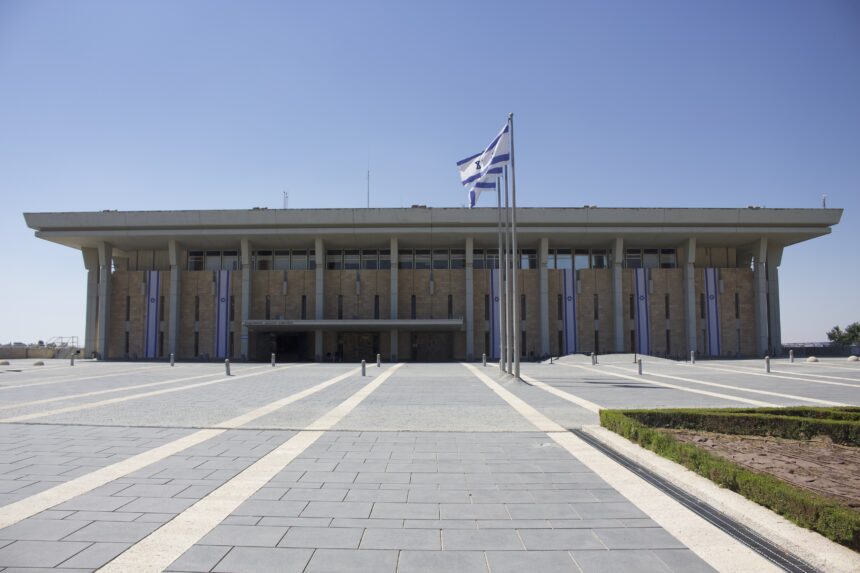
Featured photograph: Clema12 / Wikimedia Commons, 2022 (CC BY-SA 4.0), reused from Votendi’s existing media library.