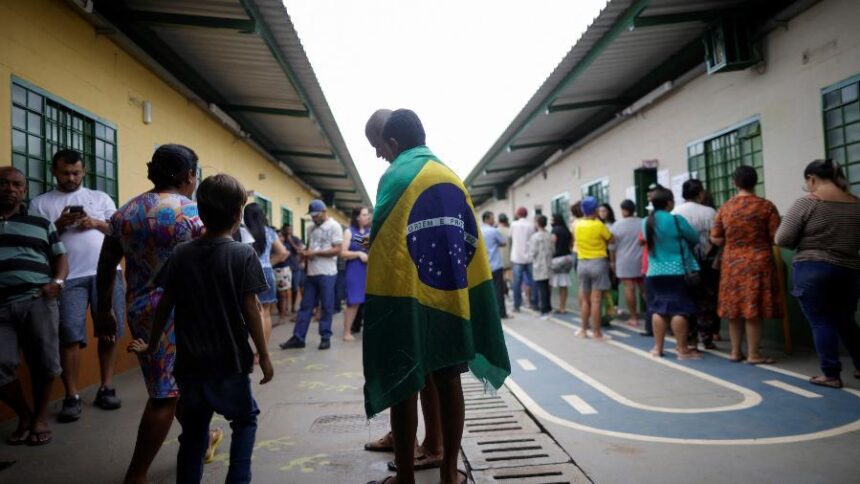
With five days remaining before Brazil’s October 25 presidential runoff, the latest national surveys show a close contest between Flávio Bolsonaro and President Luiz Inácio Lula da Silva. But beyond their headline percentages, a separate finding points to an important source of uncertainty: some voters have still not fully settled their decision.
In a RealTime Big Data survey released on Tuesday, October 20, 93% of respondents said their vote was defined, leaving 7% who had not settled on a choice. That measure of certainty should not be confused with the share selecting “don’t know” when asked which candidate they would support. The two questions capture different kinds of uncertainty.
Two new polls, two narrow margins
Both national studies released Tuesday put Bolsonaro numerically ahead when only valid votes are counted. RealTime Big Data recorded 52% for Bolsonaro and 48% for Lula; Alfa Inteligência reported 51.5% and 48.5%, respectively. Each institute described the race as a statistical tie within its stated margin of error.
| Poll released October 20 | Bolsonaro (valid votes) | Lula (valid votes) | Sample |
|---|---|---|---|
| RealTime Big Data | 52.0% | 48.0% | 2,000 |
| Alfa Inteligência | 51.5% | 48.5% | 2,700 |
RealTime Big Data surveyed voters by telephone on October 15–19, with a stated margin of error of ±2 percentage points (TSE BR-02952/2026). Alfa surveyed voters face-to-face over the same dates, with a stated margin of ±1.9 points (TSE BR-00820/2026). These are separate polls, not a Votendi polling average or forecast. Sources: UOL / RealTime Big Data and CNN Brasil / Alfa Inteligência.
The figures describe voting intentions at the time of interviewing. They do not establish the outcome of the runoff, nor do they measure how every uncertain respondent will eventually vote.
Why 7% uncertain is not the same as 2% undecided
The RealTime survey presents a clear illustration of the difference between asking respondents about a candidate and asking how firmly they have decided.
On its total-vote measure, which includes respondents who are not choosing either candidate, the institute found Bolsonaro at 48%, Lula at 45%, blank or invalid votes at 5%, and “don’t know/no answer” at 2%.
Yet a separate measure found that 7% had not definitively settled on a vote. This can include respondents who currently express a preference but might reconsider it. It is therefore incorrect to add that 7% to the 2% “don’t know” figure, or to treat all of those voters as a single pool waiting to be allocated to one candidate.
Alfa also illustrates the distinction. Its total-vote results were Bolsonaro 48.8%, Lula 45.9%, blank/null/none 3.5%, and unsure/no answer 1.8%. Removing the latter categories produces its 51.5%–48.5% valid-vote headline. Different questions and different polling methods make such figures useful for context, but not interchangeable.
A blank vote is not automatically a vote waiting to be won
There are at least three different electoral behaviors in these findings. One person may currently support a candidate but remain open to switching. Another may genuinely be undecided between the candidates. A third may intend to cast a blank or invalid ballot or not participate at all.
Those groups should not be collapsed into one “persuadable” category. In particular, reported blank or invalid votes are not valid votes under Brazil’s runoff counting rules, and they cannot be assigned to a candidate without evidence.
Turnout is a related but separate question. Even supporters who are certain about their preferred candidate must still cast a ballot for that preference to count. The last days of the campaign will therefore involve both voter persuasion and mobilisation, but the polling figures by themselves cannot tell us which effort will change the result.
What the latest poll margins do — and do not — show
Tuesday’s studies broadly agree on the direction of the numerical gap, although they use different interview modes and samples. The gap in RealTime Big Data is four points in valid votes; Alfa reports three. Both are close relative to the institutes’ stated sampling uncertainties.
Earlier results add perspective rather than certainty. On October 19, BTG/Nexus reported 50.3% for Bolsonaro and 49.7% for Lula among valid votes, while AtlasIntel/Bloomberg reported 51.1% and 48.9%. The studies have different fieldwork periods, samples and collection methods. They should not be stitched together as if they were successive days of one continuous tracking poll.
For identifying a genuine change in direction, a consistent movement within one institute’s comparable polling series is generally more informative than simply comparing a Tuesday result with a Monday result from a different organisation.
What to watch before October 25
Three measures deserve particular attention in the remaining days: whether the valid-vote margin changes within comparable surveys; whether the percentage of voters describing their choice as firm changes; and whether turnout intentions diverge between the candidates’ supporters and other respondents.
Any new poll should be read with its interviewing dates, sample and methodology. A study published after a televised debate may still include interviews conducted before it, limiting what can be inferred about the event’s effects.
Votendi will continue to record new surveys individually in the Brazil 2026 election tracker. For broader context on why the latest published polls are close despite a frequent numerical lead for Bolsonaro, read our October 19 polling analysis.
Sources: UOL (RealTime results and methodology), Bloomberg Línea (voter certainty), CNN Brasil (Alfa results and methodology), BOL/UOL (Alfa total-vote breakdown), October 20, 2026. Polls reflect survey estimates, not official election results or a Votendi forecast.